Guides
Best Interview Preparation Platforms in 2026
Five platforms compared on question accuracy, practice experience and learning support, with what each one does well, where it falls short, and who should use it.

Amney MounirFounder at Dataford · Sr. Product Growth at Meta
Aug 6, 2026 · 10 min readTechnical interviews have changed significantly. Companies are no longer evaluating candidates only on whether they can write correct code in SQL, Python, or another programming language. Depending on the role, candidates may also need to solve business problems, design systems, analyze experiments, and communicate their thinking clearly.
The difficult part is that every company has different expectations. Two companies hiring for the same position may ask completely different questions or structure their interviews in very different ways. One might emphasize coding, while another focuses more on business sense, experimentation, or system design.
Knowing what to expect beforehand can give candidates a major advantage, especially in today's competitive job market. This guide compares five of the best interview preparation platforms in 2026, including what each platform does well, where it falls short, and who should use it.
Criteria
What makes a great interview preparation platform?
I evaluated each platform using three criteria:
01Question accuracy. Does the platform provide an accurate list of questions and topics candidates can expect for their target company and role? General practice is helpful, but preparing for questions that closely resemble the real interview is much more valuable.
02Practice experience. Can candidates practice in an environment that resembles the actual interview? This may include a coding environment, timed exercises, realistic mock interviews, or opportunities to explain answers out loud.
03Learning support. Does the platform provide solutions, explanations, feedback, or coaching that helps candidates improve? Practicing questions is only part of the process. Candidates also need to understand why an answer works, where they made mistakes, and how they can improve their approach.
The best platforms help candidates understand what to expect, practice in a realistic environment, and learn from every attempt.
Comparison
The five platforms
01
Dataford
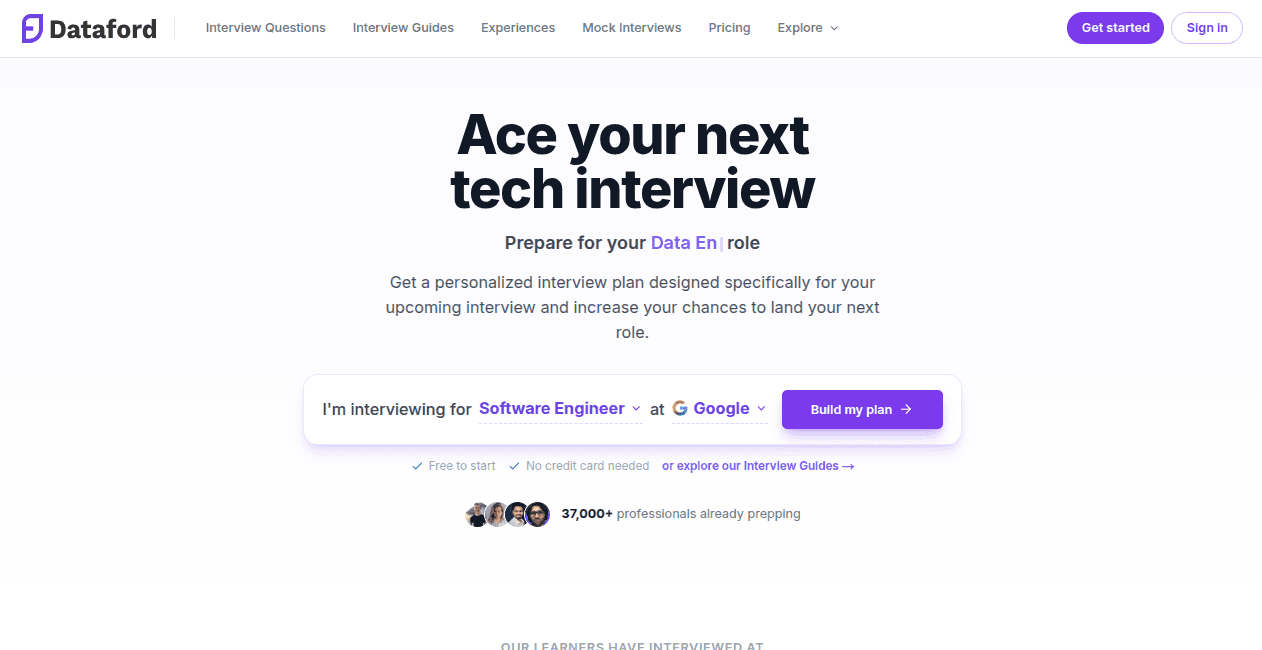
Dataford organizes interview preparation around specific companies and roles. Candidates select the company and position they are targeting to find relevant questions, interview guides, and information about how that employer typically structures its hiring process.
This matters because companies hiring for similar positions may evaluate candidates very differently. A data analyst interview at Stripe, for example, may look completely different from one at Walmart.
Dataford covers more than 7,000 companies, over 50 roles, and 500,000 interview questions across data, engineering, product, AI, and other technology functions.
The platform is particularly valuable when an interview is already scheduled and preparation time is limited. Its main limitation is that it may feel overwhelming for complete beginners who do not yet have a target company or role.
Question accuracyThis is Dataford's biggest strength. Its large breadth of questions across thousands of company-and-role combinations makes it more likely that candidates will find questions closely aligned with their actual interview. Rather than preparing from a generic question bank, candidates can focus on what a specific employer is likely to ask for their exact role.
Practice experienceCandidates can practice technical questions in interactive environments and prepare for different parts of the interview, including coding, business sense, experimentation, system design, product cases, and behavioral questions.
Learning supportDataford provides solutions and explanations designed to help candidates understand the reasoning behind an answer rather than simply memorize it.
ProsStrong question accuracy across company-and-role combinationsMore than 500,000 interview questionsCoverage across 7,000+ companies and 50+ rolesSupports technical and business problem-solvingInteractive practice environmentsSolutions and explanations across multiple interview topics
ConsLess suitable for candidates without a target roleThe large content library can feel overwhelming for beginnersMore focused on interview preparation than teaching every skill from the ground up
Best forCandidates who want highly relevant questions for a specific company and role, along with the tools and explanations needed to practice them.
02
Exponent
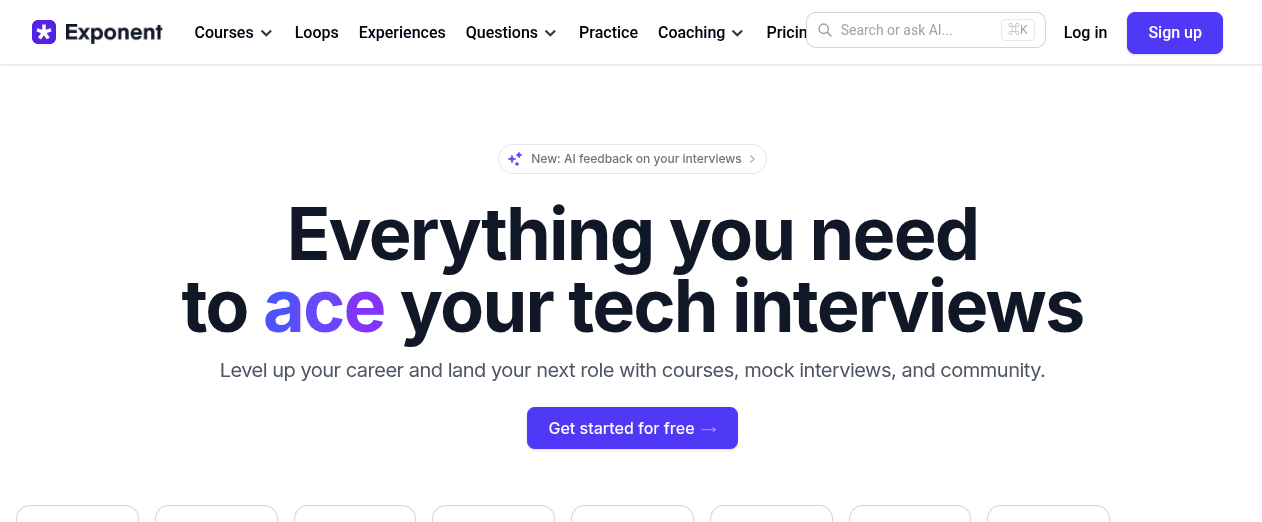
Exponent is one of the most polished platforms for candidates who prefer structured learning. It offers dedicated courses for product management, software engineering, data science, data analytics, data engineering, machine learning, system design, SQL, and several other technical areas.
Instead of presenting candidates with only a question bank, Exponent organizes its content into guided learning paths. Its biggest differentiator is access to human coaching. Candidates can book mock interviews and individual sessions with experienced professionals. Exponent also provides resume reviews and salary negotiation support.
The main limitation is role coverage. Exponent serves its core technical and product roles well, but candidates targeting positions outside those categories may not find a relevant track.
Question accuracyExponent provides high-quality questions for its supported roles, although its content is generally organized around role categories rather than a large number of specific company-role combinations.
Practice experienceThe platform offers mock interviews, practice questions, and human coaching. This makes it particularly strong for interviews where communication and structured thinking matter.
Learning supportIts courses, example answers, coaching, and feedback give candidates several ways to understand their mistakes and improve.
ProsWell-structured coursesStrong human coaching and mock interviewsCovers technical and problem-solving skillsClean and user-friendly experienceHelpful example answers and explanations
ConsCovers a relatively limited number of rolesLess company-specific than DatafordCoaching sessions can increase the total cost
Best forCandidates who want a guided learning path combined with coaching and mock interviews.
03
Final Round AI
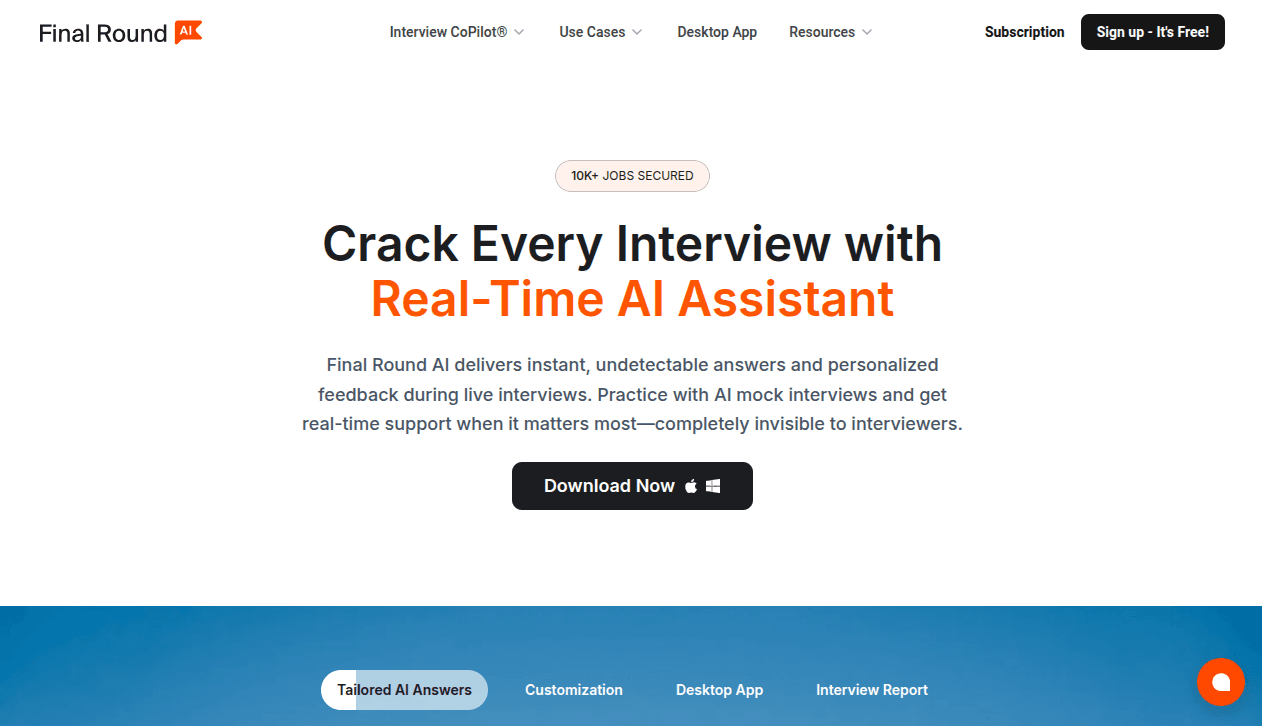
Many candidates spend considerable time preparing what they will say but very little time practicing how they will say it. Final Round AI focuses on this overlooked part of interview preparation.
The platform uses AI interviewers and realistic avatars to simulate an actual interview. Questions can be tailored using the candidate's resume, experience, and target role. This helps candidates practice thinking out loud, explaining decisions, asking clarifying questions, and structuring answers under pressure.
Final Round AI works best when paired with another platform that provides more precise company-specific or technical preparation.
Question accuracyQuestions can be personalized using the resume and job description, but they may not always match the specific questions or process used by an individual company.
Practice experienceThis is the platform's biggest strength. The AI interview experience feels much closer to a live interview than answering questions alone.
Learning supportCandidates receive AI-generated feedback that can help them improve their answers, delivery, and communication. However, the feedback can sometimes feel generic.
ProsRealistic AI mock interview experienceHelps candidates practice communicating under pressureUses the resume and job description to personalize questionsUseful across technical, behavioral, and problem-solving interviews
ConsLimited company-specific accuracyFeedback can occasionally feel genericCannot fully replace an experienced human interviewer
Best forCandidates who understand the material but need to improve how they communicate their answers.
04
DataLemur
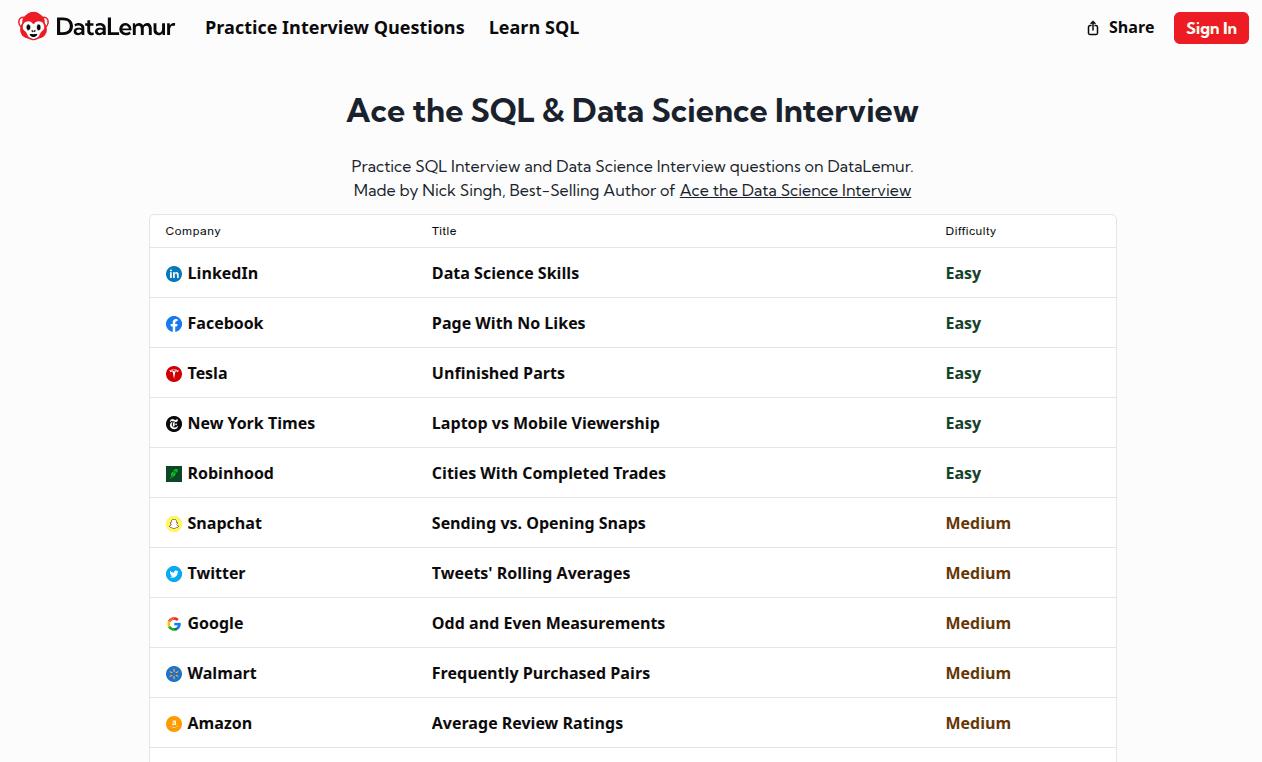
DataLemur is one of the strongest options for candidates preparing for data interviews, particularly when SQL is a major part of the process.
The platform offers SQL questions inspired by real companies. Its exercises focus on practical problems that resemble what candidates may encounter during technical screens. DataLemur also offers useful free content, making it accessible to candidates who are not ready to pay for a complete interview preparation platform.
Its focused approach is both its greatest strength and its primary limitation. Many interviews also include Python, experimentation, statistics, business sense, behavioral questions, and product cases.
Question accuracyDataLemur offers relevant company-style SQL questions, although it provides less visibility into the complete interview process for a specific company and role.
Practice experienceCandidates can write and test SQL directly on the platform, creating an experience similar to a technical assessment.
Learning supportIts solution explanations help candidates understand the reasoning behind each query instead of only showing the final answer.
ProsStrong SQL interview questionsInteractive SQL practiceClear explanations and solutionsUseful free contentProblems resemble real technical screens
ConsPrimarily focused on SQL and data rolesLimited coverage of complete interview processesLess useful for business, behavioral, and communication practice
Best forCandidates who want to improve their SQL and technical problem-solving skills.
05
LeetCode
LeetCode remains one of the most recognized technical interview preparation platforms. Its question bank is enormous, its coding environment is reliable, and its community provides multiple solutions and explanations for most problems.
For software engineering interviews, it remains one of the strongest resources available. It is especially useful for practicing algorithms, data structures, and coding under time constraints. LeetCode also includes database questions for candidates who want to practice SQL fundamentals.
The main limitation is that LeetCode was designed primarily for software engineering interviews. It offers limited support for business sense, experimentation, product cases, behavioral questions, and other non-coding interviews.
Question accuracyLeetCode offers many questions associated with major companies, but candidates still need to determine which problems are relevant to their specific role and interview process.
Practice experienceIts coding environment is reliable and closely resembles a technical coding assessment. Timed contests can also help candidates practice working under pressure.
Learning supportCommunity solutions and discussions provide several ways to approach the same problem. However, the amount of information can sometimes be overwhelming.
ProsLarge and mature question bankReliable coding environmentStrong community explanationsExcellent for algorithm-heavy technical interviews
ConsMuch of the content may not be relevant to non-engineering rolesCandidates must identify the right questions themselvesLimited coverage of business and product problem-solvingDoes not prepare candidates for the complete interview process
Best forSoftware engineers, data engineers, and candidates expecting algorithm-heavy coding interviews.
Verdict
Which interview preparation platform should you use?
The right platform depends on what you need most:
DatafordYou want accurate questions for a specific company and role.
ExponentYou want structured courses and human coaching.
Final Round AIYou want to simulate a live interview with AI.
DataLemurYou want to strengthen your SQL.
LeetCodeYou are preparing for an algorithm-heavy coding interview.
In many cases, combining two platforms will produce better results than relying on only one. For example, candidates can use Dataford to understand a company's interview process and identify relevant questions, then use Final Round AI to practice explaining their answers under pressure. Another candidate might use Exponent to learn interview frameworks before turning to DataLemur or LeetCode for additional coding practice.
Method
How to prepare more effectively
Start by researching the company and understanding each stage of its interview process. Identify whether the company emphasizes coding, system design, experimentation, business sense, technical knowledge, or behavioral skills.
Next, practice the questions most relevant to that process. If you are working on a coding problem, explain your approach before writing the code. If you are solving a business case, clarify the objective and define the appropriate success metrics before suggesting solutions.
Finally, simulate the real interview. Set a timer, ask clarifying questions, and explain your thinking out loud. Review not only whether your final answer was correct, but also whether your reasoning was structured and easy to follow.
Successful preparation is not about completing the largest possible number of questions. It is about knowing what to expect, practicing in a realistic environment, and learning from every attempt.
Start with the company you are actually interviewing atDataford's interview guides cover 7,000+ companies and 50+ roles, with the questions candidates reported and how each employer structures its process.
Browse interview guidesAmney Mounir
Founder of Dataford and Sr. Product Growth at Meta. Ranked the #10 largest content creator in the US for data science, with over 80,000 followers on LinkedIn.
