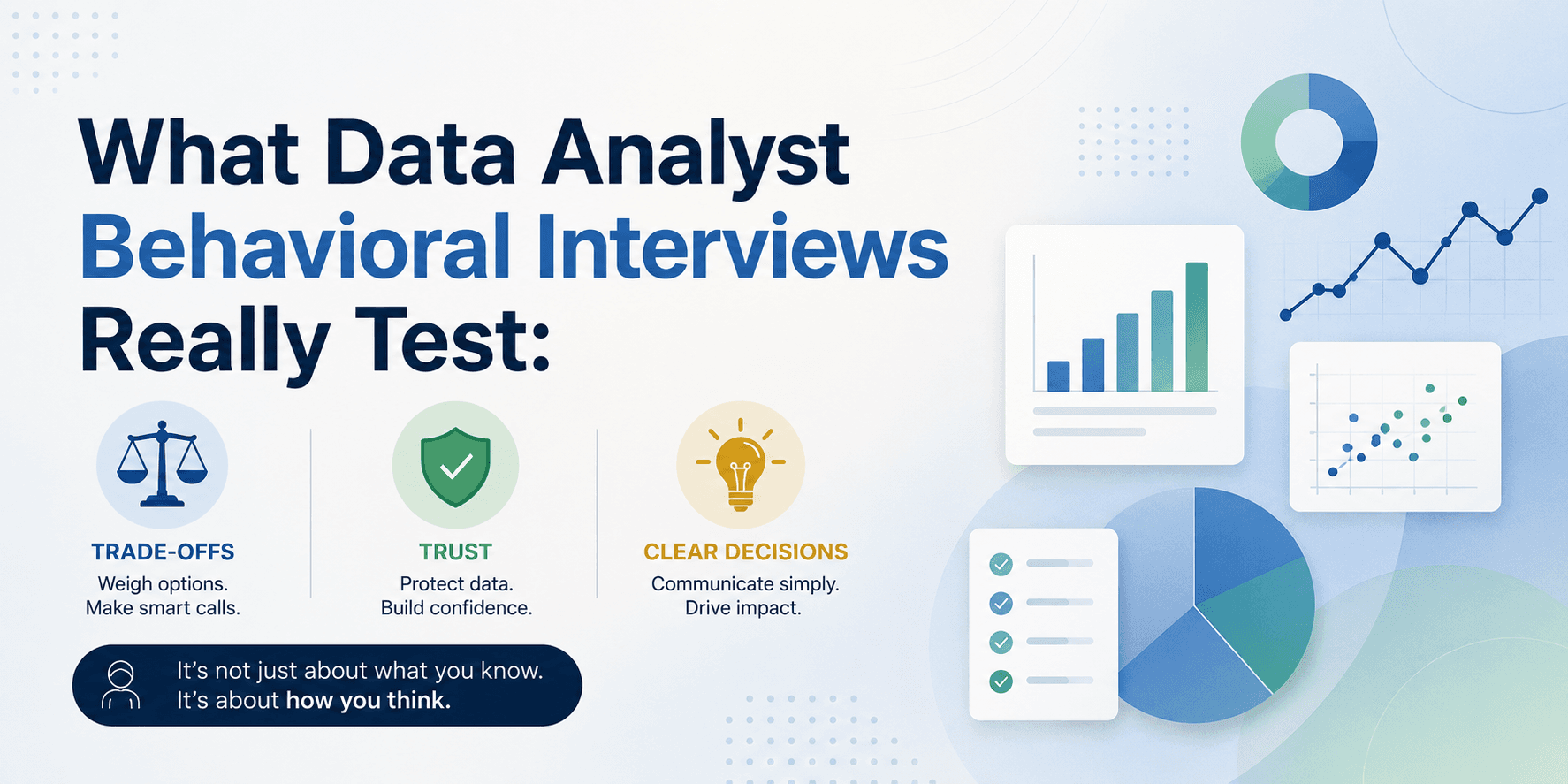
What Data Analyst Behavioral Interviews Really Test: Trade-Offs, Trust, and Clear Decisions
The dominant leadership signal for analysts is not charisma; it’s whether you can say “not yet” without sounding arbitrary.
How to answer top data analyst behavioral questions with better judgment, clearer trade-offs, and stronger stakeholder communication.
 Dataford Team 7 min read Reviewed by data hiring leads
A top-ranked behavioral question for data analysts is not about conflict in the abstract. It is about what you do when three teams want answers now and your job is to decide, explain, and absorb the fallout without sounding evasive.
That matters because candidates often prepare for “leadership” questions as if they are being asked to sound inspirational. They are usually being asked for something more practical: can you make a defensible call when capacity is limited, communicate the trade-off early, and preserve trust with people who do not get everything they want?
If you read the recurring prompts closely, the center of gravity is clear. Balancing Conflicting Analytics Requests appears far more often than the rest, and the surrounding questions lean toward explanation, disagreement, and ownership rather than people-management theory. Even when companies vary in style across guides like 1Password Data Analyst, 6sense Data Analyst, or AArete Data Analyst, they keep returning to the same practical judgment test: how you prioritize scarce analytical attention.
Why this question dominates the loop
The reason this prompt shows up so often is simple: it compresses several analyst skills into one story.
An interviewer gets to hear how you rank business impact, whether you understand deadlines versus urgency theater, how you handle competing stakeholders, and whether you protect the credibility of the work when time is tight. It is a much richer signal than “Tell me about your leadership style,” especially for an individual contributor role.
That also explains why adjacent prompts like Resolving Deadline Conflict on Analysis, Persuading a Resistant Stakeholder, and Resolving Conflict With a Peer keep resurfacing. They are all different costumes for the same underlying question: when judgment is contested, how do you keep the work useful and the relationship intact?
Company guides reinforce that emphasis in different flavors. In some environments, such as 1010data Data Analyst, the pressure is often about supporting business decisions with crisp prioritization. In others, like 7-Eleven Data Analyst or 2020 Companies Data Analyst, the practical challenge is often cross-functional coordination: multiple stakeholders, moving deadlines, and visible downstream consequences if analysis slips or misleads. You should prepare less like you’re studying “leadership questions” and more like you’re rehearsing decision quality under constraint.
What a weak answer sounds like
Keep reading — it's free
Sign up to read the full breakdown, every chart, and worked examples. No credit card needed.